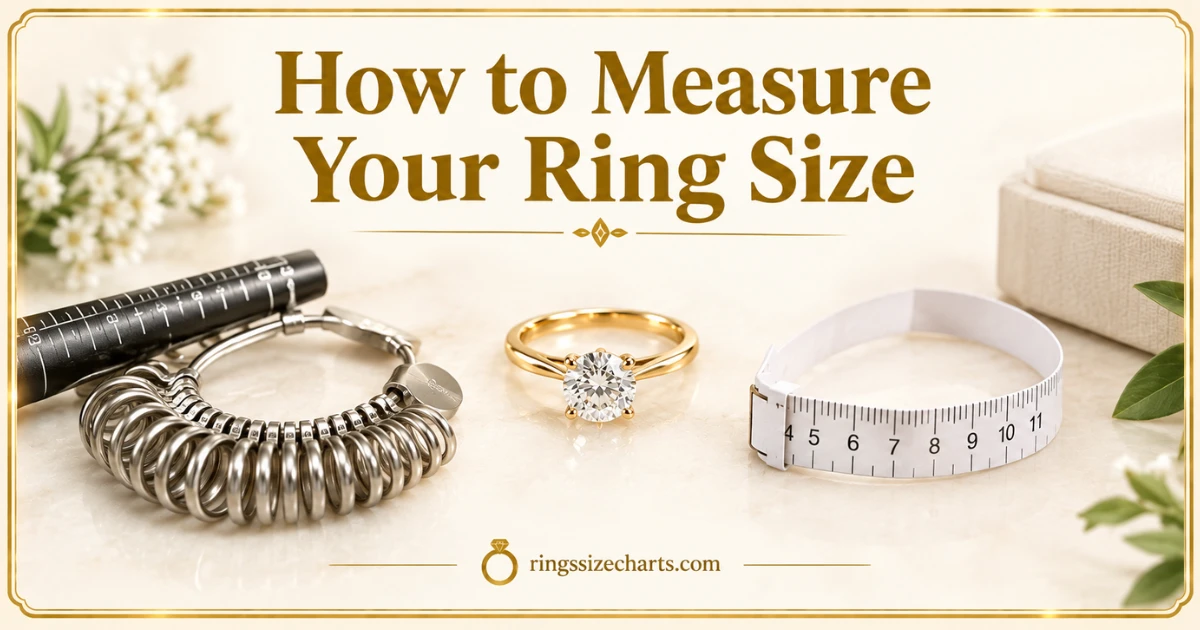
The fastest way to measure ring size without an actual ring is to wrap a string or paper strip around your finger and measure the length, then compare that number to a standard ring size chart.
Buying a ring without knowing the exact size is a common jewelry-shopping mistake, but you don’t need a professional sizer to get it right. This guide covers simple, at-home methods to find an accurate ring size using items you already own.
Understanding Ring Size Basics
Ring size refers to the inner circumference of a ring, measured in millimeters. A larger number always means a wider circle, which fits a bigger finger. Jewelers use this circumference to calculate your finger’s diameter as well, and both numbers together determine your exact ring size.
The United States uses a numeric system, typically ranging from size 3 to size 13. Other countries, including the UK, use letters like J, M, or P instead. This matters if you’re buying from an international retailer or converting a gift purchased abroad — a simple conversion chart solves the mismatch instantly.
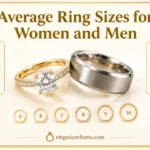
Read More: Average Ring Sizes for Women and Men
What You’ll Need
A piece of string, a thin paper strip, or even dental floss can substitute for a professional sizer, along with a ruler with millimeter markings. These are accurate enough for most shoppers — jewelers themselves often start with the same basic tools before fine-tuning with metal sizers.
A flexible measuring tape gives slightly better results than stiff paper because it curves naturally around the finger. Avoid using a stretchy material like a rubber band as your primary tool since it can distort the true circumference; save that only as a rough backup estimate.
How to Measure Using a String or Paper Strip
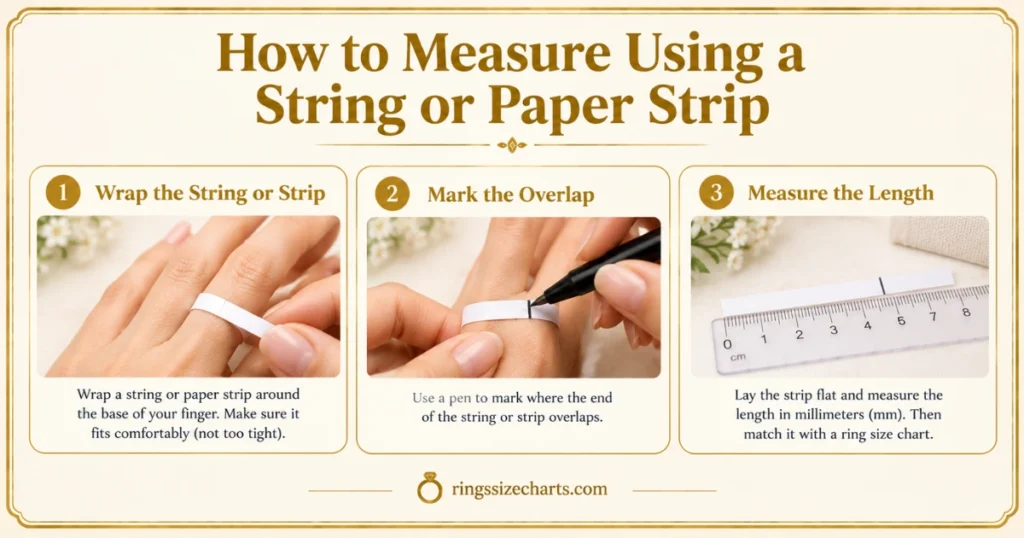
Cut a strip about four inches long and wrap it snugly around the base of your finger. It should feel secure but still slide over the knuckle without pinching. Keep the material flat against the skin as you wrap it — a twisted or angled wrap can throw off your final measurement by half a size or more.
Use a pen to mark exactly where the string or paper overlaps itself. Lay it flat on a table and measure from the starting point to that mark in millimeters. This number is your finger’s full circumference — round to the nearest whole millimeter for the cleanest result.
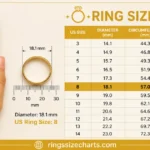
Once you have your circumference number, match it against a ring size chart. For reference, a circumference of about 54.4 mm typically equals a US size 7, and every full size increases circumference by roughly 2.5 mm — making it easy to estimate sizes between listed chart numbers.
Read More: Ring Size Chart & Guide
How to Find Ring Size Without a Ring or String
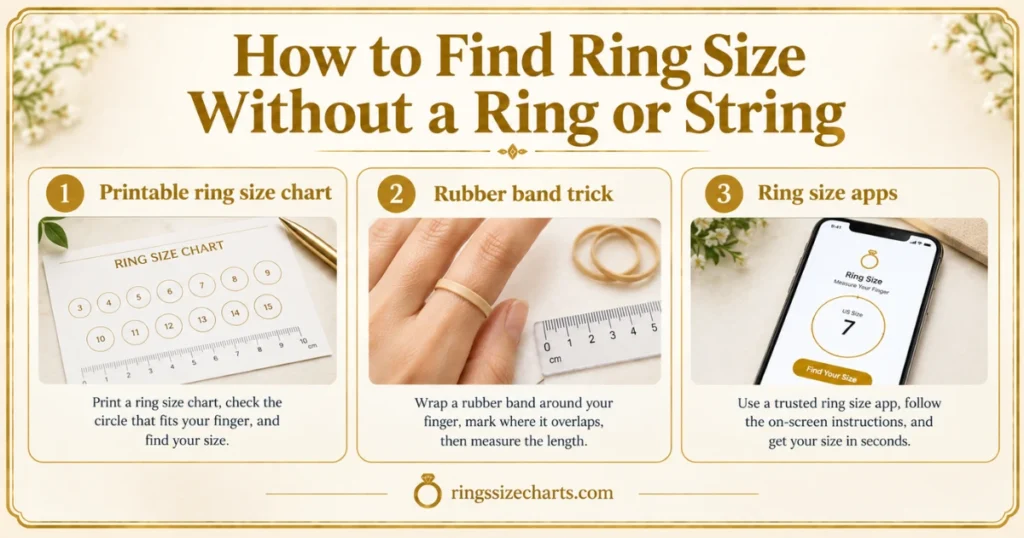
Printable ring size chart
Many jewelry websites offer a free printable chart with circles representing each size. Place your finger directly over each circle until you find a snug match. Make sure the chart prints at 100% scale — turn off “fit to page” in your browser’s print settings, since resizing throws off accuracy.
Rubber band trick
Wrap a rubber band around your finger and mark where it naturally rests without stretching, then measure that unstretched length. It’s a fast estimate, though less accurate than the string method.
Ring size apps
Several smartphone apps use your camera or a reference card to estimate finger size, but results vary with lighting and steadiness. Treat these as a starting point and double-check with the string method before buying.
How to Measure Using an Existing Ring
Pick a ring that fits the same finger you’re buying for, not just any ring in your collection — fingers vary in size across both hands. Wider band styles may also fit slightly tighter than thin bands of the same labeled size.
Place the ring flat on paper and trace the inner edge with a pencil, since that’s what determines actual fit — this gives you a visual guide to compare against printed charts. Alternatively, lay the ring flat and measure straight across the inside edge with a ruler to get the inner diameter in millimeters, then compare that to a standard chart. This remains one of the most accurate at-home methods available.
See Ring Size Calculator: Ring Size Calculator
Common Mistakes That Cause Inaccurate Measurements
Measuring cold fingers
Cold temperatures cause fingers to shrink slightly, leading to a falsely small measurement. Warm your hands first — a few minutes under warm water works well.
Pulling the string too tight
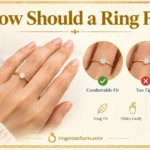
This compresses the skin and produces a falsely small circumference. The material should feel snug, not squeezed, and should still slide comfortably over the knuckle.
Ignoring time-of-day fluctuations
Fingers naturally swell throughout the day. Morning measurements often come out smaller than evening ones, so measure in the late afternoon or evening for the most reliable number.
Forgetting band width
Wider band styles (6mm or 8mm) tend to fit more snugly than thin bands, so you may need to size up slightly for comfort. Standard thin bands under 3mm rarely need this adjustment.
Factors That Affect Sizing Accuracy
Your dominant hand is often slightly larger due to regular muscle use — always measure the specific finger and hand where the ring will actually be worn.
Some fingers also have a knuckle noticeably larger than the base; if that gap is significant, consider a ring with flexible or hinged construction.
Heat, humidity, and physical activity all cause temporary swelling too, so avoid measuring right after exercise — a neutral, resting state gives the most consistent number.
How to Secretly Measure Ring Size for a Surprise Proposal
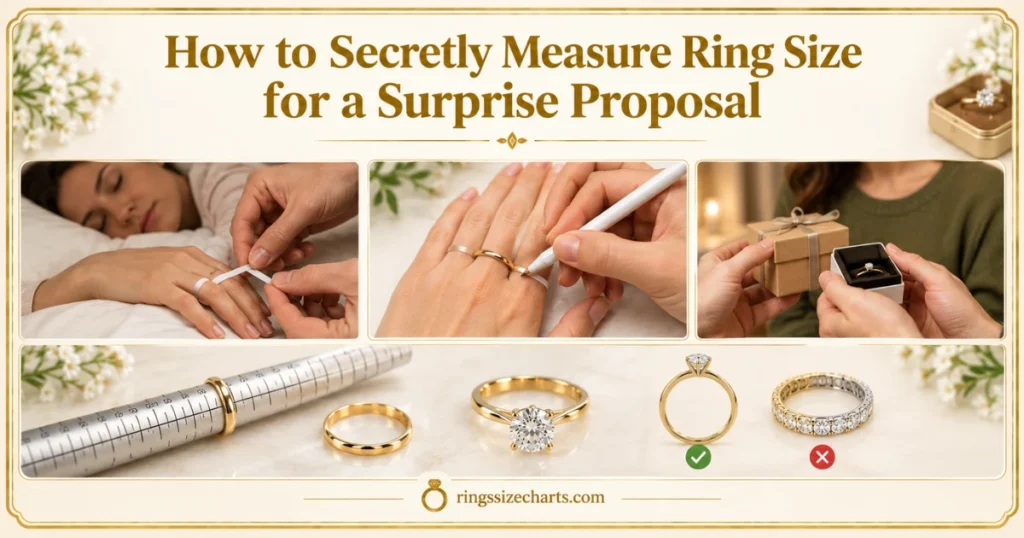
Gently wrap a soft string or paper strip around your partner’s finger while they sleep, moving slowly and marking the overlap point before removing it carefully. This works best with a deep sleeper and a light touch — practice the motion beforehand.
If your partner already wears a ring on the correct finger, you can also borrow it briefly to trace or measure, then return it to its exact original spot immediately. Choose a piece they’re unlikely to notice missing for a short time.
Close friends or family sometimes already know your partner’s size from past gifts, which can save you the guesswork entirely.
When no measurement is possible, choose a slightly larger size rather than a smaller one — most rings can be resized down easily by a jeweler afterward. Avoid rings with stones set fully around the band, since these are harder to resize; a simple solitaire setting resizes with far less difficulty.
When to Use a Professional Ring Sizer Instead
DIY methods work well, but a jeweler’s metal ring sizer set offers more consistent results than string or paper, since metal doesn’t stretch or compress. For high-value purchases like engagement rings, an in-store fitting is worth the extra step to confirm your at-home estimate.
Many jewelry retailers also mail out free plastic ring sizer kits on request. These closely mimic the feel of an actual ring and typically arrive within a few days, making them a convenient middle ground between DIY and in-store sizing.
Tips for Buying Rings Online Without an Exact Size
Adjustable rings offer a flexible option when you’re unsure of the exact size needed, since they can expand or contract slightly to absorb small sizing errors. They work best for fashion rings rather than fine jewelry with delicate stone settings — for permanent pieces, a fixed and properly measured size is the better choice.
Before ordering online, always check the retailer’s resizing or return policy. Most reputable jewelers offer at least one free resize within the first 60 days, which makes online ring shopping far less risky.
Conclusion
Measuring ring size without an actual ring is simple once you know the right method. String, paper, and printable charts all offer accurate, budget-friendly solutions. With a little care and the right timing, you can get a confident, correct fit every time.
Frequently Asked Questions
Can I measure ring size with my phone?
Yes, several ring size apps use your camera and a reference card to estimate size, though results are less precise than the string method.
What is my ring size if my finger is 2.5 inches?
A 2.5-inch circumference converts to roughly 63.5 mm, which lines up closely with a US size 9 on most standard charts.
How do you secretly measure ring size?
The most common approach is gently measuring a sleeping partner’s finger with string, or borrowing a ring they already wear briefly.
Is a size 7 ring big for a girl?
A size 7 falls within the average range for women in the US, making it neither unusually large nor small for most adult hands.

Hi, I’m Wesley Turner, the admin at RingsSizeCharts.com. We simplify ring sizing, measurements, and size conversions with easy-to-follow guides, accurate charts, and practical tips to help you find the perfect ring fit with confidence.